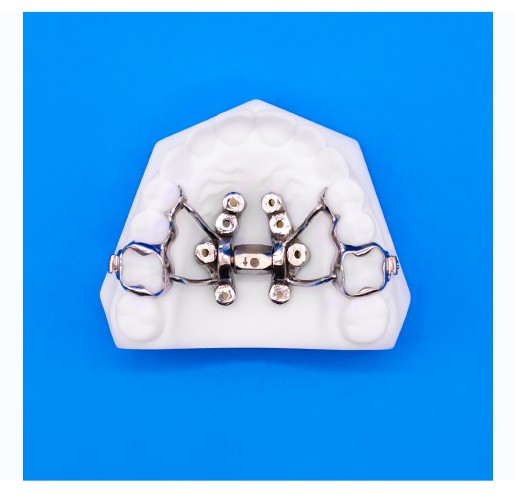
According to Isil Aras and colleagues, orthodontic researchers writing in The Angle Orthodontist (2025), "the MARPE group exhibited greater expansion in nasal, maxillary basal, and alveolar widths compared to the RPE group," with significantly increased nasal airflow after MARPE where the conventional tooth-borne RPE group's airflow stayed essentially unchanged (Aras et al., The Angle Orthodontist, 96(1), 2025).
If you're a singer deciding which device is best for you, the short answer is: it depends on how much space you're starting with, what you need out of your career timeline, and what secondary benefit you're chasing besides the expansion itself. There's no single "best" expander for singers — there are fore runners! But it starts with your own priorities, not with whatever device your orthodontist happens to use most.
Do I need a removable expander if I'm a working professional singer?
Not automatically (I didn't!). A fixed appliance doesn't necessarily interfere with singing or a professional schedule — I had a surgically implanted expander (MARPE) while actively pursuing a professional career, including professional recordings for auditions during treatment, and it didn't meaningfully affect my technique or vocal production. One of the real variables is how much space you're starting with. If your upper arch is already very narrow, adding any kind of appliance shrinks your working space further, and that can genuinely limit your technique during a demanding season of gigging. But if you're starting with a fair amount of space, a fixed device sitting in your mouth full-time usually isn't a problem. This is a starting-anatomy question first, a career-schedule question second.
What's the difference between different expansion devices like MARPE, ALF, Schwartz, and more?
There are hundreds of different types of expanders! But they fall into certain categories of function: fixed vs. removable, skeletal-palatal vs. dental. They don't just differ in how they look — they differ in what they're built to prioritize. There are also lots of devices that function pretty much the same way, but just have different names — just to make it extra confusing!
MARPE (Micro-implant Assisted Rapid Palatal Expansion) (and other similar devices like TADs, MSE) is screwed into the hard palate bone rather than resting on the teeth, which lets it expand the nasal cavity more directly than tooth-borne options. It's fixed (not removable) and has the potential to move faster timeline-wise than other expanders.
ALF (Advanced Lightwire Functional) (aka Crozat) is removable and is used heavily in the myofunctional community because its secondary focus is bite, craniosacral integration, tongue posture, and full-body postural stabilization, not just palate width. It's also the smallest option, near invisible when in, and takes up almost no room, which can be a great choice for someone starting from a very narrow arch. Its tradeoff is upkeep — it typically requires adjustment visits every two to four weeks, which is difficult for anyone touring or traveling for work. I've worn a Schwartz, a Crozat, and a MARPE, in that order, and the Crozat remains one of my favorite appliances for how little it interfered with day-to-day singing — even though it was removable, it was so small I could sing with it in with zero changes or adjustments.
Schwartz (a standard acrylic expander) is removable, turned with a small key, and generally the least expensive option. Because it expands by pressing on the teeth rather than the bone, it has a ceiling: someone who needs a very large amount of expansion may not be able to reach their full target width with a Schwartz or other dental-borne devices alone, depending on your starting shape.
Fixed acrylic appliances like Haas and Biederman are similar in size/look to a Schwartz, but not removable. They are a good budget-friendly choice, but personally, I think if you're going to wear a fixed appliance, there are better options.
Does expanding the palate actually help singing?
There isn't yet a large published study measuring palatal expansion's effect on singing specifically — as of this writing, that research doesn't exist. But I can confirm, through both my own personal experience and that of some of my past clients, that they got huge changes in their singing. Common changes are: more ring, more "dome" and buoyancy in the sound, ability to "pocket" pitches (especially high notes), better chiaroscuro balance, more stability in the tone, and more resonance overall.
What does exist is airway and breathing research that singers can reasonably extend to their own goals, since pharyngeal and nasal space are directly relevant to resonance and breath management. A meta-analysis of adults treated with MARPE found significant increases in both nasal cavity volume (WMD 1.24 cm³) and nasopharyngeal volume (MD 0.75 cm³) (Liu, Wang & Liu, BMC Oral Health, 2023). And in a randomized clinical trial comparing MARPE to conventional tooth-borne RPE, MARPE produced significantly greater increases in nasal airflow and a greater reduction in nasal resistance, while the RPE group's airflow stayed essentially unchanged over the same four months — though both appliances achieved comparable rates of opening the midpalatal suture (RPE 53%, MARPE 60%) (Aras et al., The Angle Orthodontist, 96(1), 2025). Neither study measured singing outcomes directly, but both point to the same mechanism singers care about: more usable nasal and pharyngeal space after expansion.
Across our own singer clients at OPUS MYO, the pattern we observe is that reduced nasal breathing and "swallowed" vocal placement often show up together — singers who struggle to find an easy, natural "chiaro" brightness frequently also report chronic nasal congestion or mouth breathing. That's an observational pattern from our business and not a controlled study, but it's consistent with what the airway research above would predict.
Which expander works fastest?
MARPE is generally the quickest through the active expansion phase, since it works directly on bone rather than waiting on tooth movement. That doesn't shorten the full orthodontic treatment — braces to align the bite still take time after any expander — but it does mean change normally happens sooner, and relief potentially comes faster.
Which expander is least visible?
Crozat is the most discreet in terms of both appearance and mouth space — it's essentially invisible and very lightweight. MARPE is also relatively hidden since it doesn't sit on visible teeth, though depending on your starting width it can create a gap between the front teeth as it works.
Do I still need braces after expansion?
Yes. Every expander widens the arch, but none of them align the bite — that's what braces (or clear aligners like Invisalign) do afterward. If the plan is expansion without any bite correction at all, that's not a complete orthodontic plan and can cause real health issues, so make sure to budget and timeline for both phases.
How do I find the right orthodontist for a singer?
Start with your own priorities. Most orthodontists are trained in one, two, or at max a handful of expander types and will usually recommend whichever one they use most often — that's not a flaw, it's just specialization, but it means the recommendation may not account for what you actually need as a performer. Decide first whether you need something removable, what secondary benefit matters most to you (nasal breathing, sleep, bite, posture, soft palate, etc.), and whether your touring schedule allows for frequent in-office adjustments. Then look for a provider who already works with the specific device that fits those answers — ideally one experienced with adult patients, and, if relevant, one who specializes in airway or TMJ-focused treatment.
Which expander does Jessica recommend most?
MARPE, for most adult singers, most of the time. It's not right for everyone — it's fixed, and the fast timeline isn't guaranteed to suit every case — but adult bone doesn't move as easily as a child's, and MARPE tends to get adults closer to their full expansion goal without the ceiling that tooth-borne expanders can run into. It also has a proven track record in the research above of measurable enlargement of nasal cavity and pharyngeal (airway) space compared to conventional tooth-borne expanders.
What should I do next?
Map your own priorities first — removable or not, what secondary benefit you want, and what your schedule allows — before you sit down with an orthodontist. If you'd like a second opinion on how a specific expander option fits your voice and your career stage, that's the kind of individualized question a consult is built for.